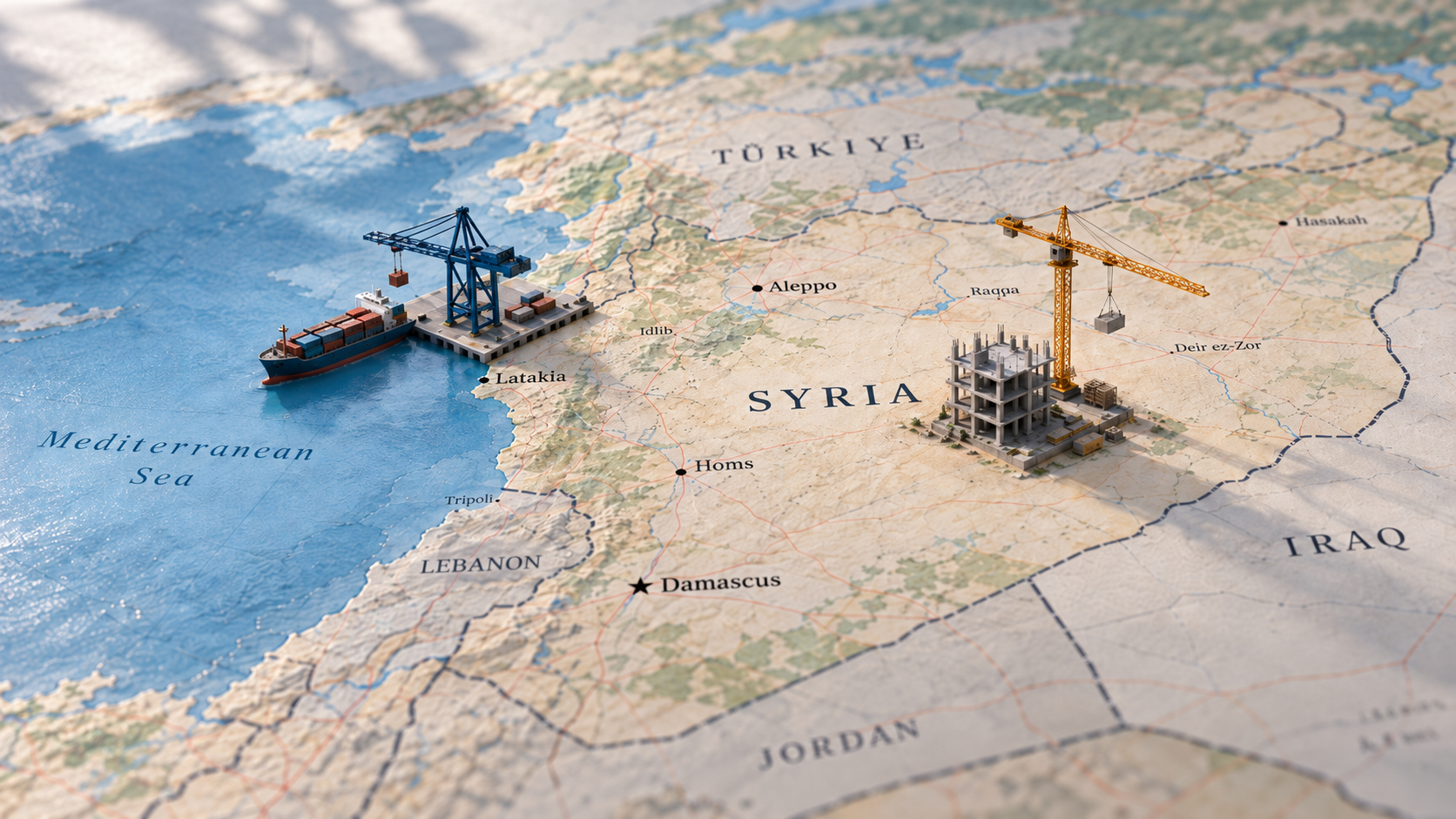
Following the change in government in December 2024, Syria has entered a new cycle of economic and institutional development. The country is rebuilding critical infrastructure, restructuring state institutions and establishing new mechanisms for attracting foreign capital. At the same time, its external economic relationships are changing: Damascus is seeking to diversify its partners and attract capital from Turkey, the Gulf states, Europe, the United States, Russia and China.
Against this backdrop, Syria is gradually emerging as a competitive market for investors, where access to projects depends not only on financial capacity but also on the ability to understand the evolving decision-making system, the interests of key stakeholders and the Syrian administration’s long-term priorities.
The study examines the prospects for Syria’s economic development, the emerging decision-making architecture around President Ahmed al-Sharaa, the positions of major external players and the sectors with the greatest investment potential. Particular attention is given to Russia’s accumulated political capital in Syria and the prospects for converting it into economic presence under the new conditions.
The report also examines changes to the sanctions regime on Syria and their impact on the investment landscape, as well as the role of transport infrastructure, ports and regional economic ties in shaping Syria’s new position in the Middle East.
The full analytical report in English is available here.
An expert commentary based on the study has also been published by RBC (RosBusinessConsulting).
Below are the study’s key findings.
Syria is entering a new investment cycle
The recovery of the Syrian economy begins with infrastructure development and the creation of institutions capable of supporting further capital inflows. Projects already underway or announced cover energy, transport, ports, aviation, telecommunications, healthcare, agriculture and real estate development.
At the same time, the scale of investment required significantly exceeds the current capacity of the Syrian economy. According to the World Bank, the cost of rebuilding the country is estimated at approximately $216 billion — almost ten times Syria’s 2024 GDP.
At this early stage, the government therefore needs not only capital, but also partnerships that can support infrastructure reconstruction, build institutional capacity and establish new economic linkages.
The advantages of early entry may outweigh short-term returns
Early entry into the Syrian market comes with a high degree of uncertainty. Investors face evolving regulation, limited visibility on demand, political risks and the need to establish relationships with new institutions and local partners.
These factors may constrain short-term investment returns. However, for early market entrants, the value of a project extends beyond its immediate financial performance.
Early investors have an opportunity to understand the emerging decision-making system ahead of competitors, build relationships with relevant interest groups, establish a local track record and secure positions within an economic architecture that is still taking shape. Investment can therefore serve as a means of securing long-term market access and creating a strategic option on future market development.
Major foreign investors are already taking advantage of this dynamic by establishing a presence in ports, energy, infrastructure, telecommunications and real estate development.
Market access increasingly depends on the emerging decision-making architecture
Following the change in government, Syria is developing a new system for the distribution of political and economic authority. An important role is played by the presidential center around Ahmed al-Sharaa — a combination of formal institutions and informal channels of influence connected to the president and his immediate political circle.
The high concentration of decision-making increases the value of direct access to key stakeholders. For investors, understanding who controls decisions related to a particular sector, licensing, infrastructure, land assets or public procurement is becoming no less important than assessing the project’s financial model.
At the same time, the new administration does not appear to be seeking dependence on a single external partner. Diversifying external relationships allows Syria to attract competing sources of capital while preserving room for maneuver in its foreign and economic policy.
Transport infrastructure could turn Syria into a regional hub
Foreign investors’ interest in Syria is driven not only by the scale of the country’s reconstruction needs. Its geographic position creates the potential for a regional logistics hub connecting the Mediterranean with Turkey, Iraq, Jordan and the Gulf states.
As the cost and risks associated with long-distance maritime and air transport increase, reliable overland routes and distribution centers become more strategically important. In this context, Syria could potentially reclaim its role as a link between different parts of the region — effectively serving as a classic trade and logistics hub for the Levant.
This is why different external players are seeking to establish economic positions in Syria, particularly where their future regional supply chains could run through the country. Competition is therefore extending beyond individual projects to infrastructure nodes capable of shaping the direction of future trade flows.
Syria’s current stage of economic development creates an additional advantage. While infrastructure, institutions and supply chains are still being built, investors have greater opportunities to secure strategic positions than in established markets where assets and influence are already firmly distributed. This is why competition for Syria’s transport infrastructure is already extending beyond its immediate neighbors. For example, French shipping group CMA CGM has entered into an agreement to develop and modernize port infrastructure in Latakia, strengthening its position in one of the key maritime nodes of Syria’s emerging logistics system.
Sanctions relief expands investment opportunities but does not eliminate political risks
The change in government in Syria was accompanied by a major revision of the sanctions regime. In 2025–2026, the principal economic restrictions imposed on the Syrian state under the previous regime were lifted, including the Caesar Act. This significantly expanded the scope for foreign participation in Syria’s reconstruction and economic development.
However, sanctions relief does not mean that Damascus has abandoned a cautious approach to the origin of foreign capital. The Syrian administration has an interest in diversifying its external partners as broadly as possible and may therefore consider how the participation of investors from particular countries could affect other investors’ willingness to enter the market. In some sensitive sectors, Russian capital may consequently be assessed in terms of its potential impact on the ability to attract Western, Turkish and Middle Eastern investment.
At the same time, regime change and sanctions relief do not eliminate political risk. Investors still need to account for changes in government policy, security conditions, institutional and financial-system capacity, regulation, access to infrastructure and the durability of relationships with key stakeholders.
These risks do not necessarily prevent investment, but they affect project economics: political uncertainty is reflected in project valuations, required returns, transaction structures and market-entry terms. As the investment environment opens up following sanctions relief, more rigorous assessment of the political and institutional environment therefore becomes increasingly important.
Russia retains political capital but must adapt to the new system
Russia has accumulated significant political, institutional and infrastructure capital in Syria over several decades. Bilateral ties developed during the Soviet period and have encompassed military-technical cooperation, trade and economic relations, and infrastructure presence.
At the same time, the reassessment of the role of Russian facilities in Tartus and Hmeimim in 2026 changes the conditions for Russia’s future presence. This does not automatically mean that Russia has lost its accumulated political capital, but it reduces the extent to which the previous model of engagement can serve as a source of economic advantage.
For Russian businesses, this means the need to remap Syria’s stakeholder landscape: identify decision-making centers, local interest groups, licensing and public procurement mechanisms, access to infrastructure and potential local partners.
A realistic strategy may involve gradually expanding market presence — from exports and distribution to local partnerships, joint ventures and production localization. This approach allows companies to build market knowledge and stakeholder relationships before committing to more capital-intensive investments.
Key takeaway
The emerging Syrian market offers the potential for early entrants to build long-term advantages despite elevated uncertainty and limited short-term returns on some projects.
For foreign investors, competition is not only about the financial returns generated by individual assets, but also about gaining early access to the emerging decision-making system, local partners, infrastructure and future regional value chains.
For Russia, the key question is not whether it retains the political capital accumulated through decades of cooperation with Syria, but whether it can adapt that capital to the country’s new institutional and competitive environment. The reassessment of Russia’s previous model of engagement makes it necessary to develop a deeper understanding of the new architecture of influence and identify sectors where Russian businesses can compete on market terms.
The Syrian market remains open to multiple external centers of influence. This competition gives the new administration greater scope to diversify its partnerships, while giving early investors an opportunity to secure positions before the country’s economic and institutional architecture becomes fully established.