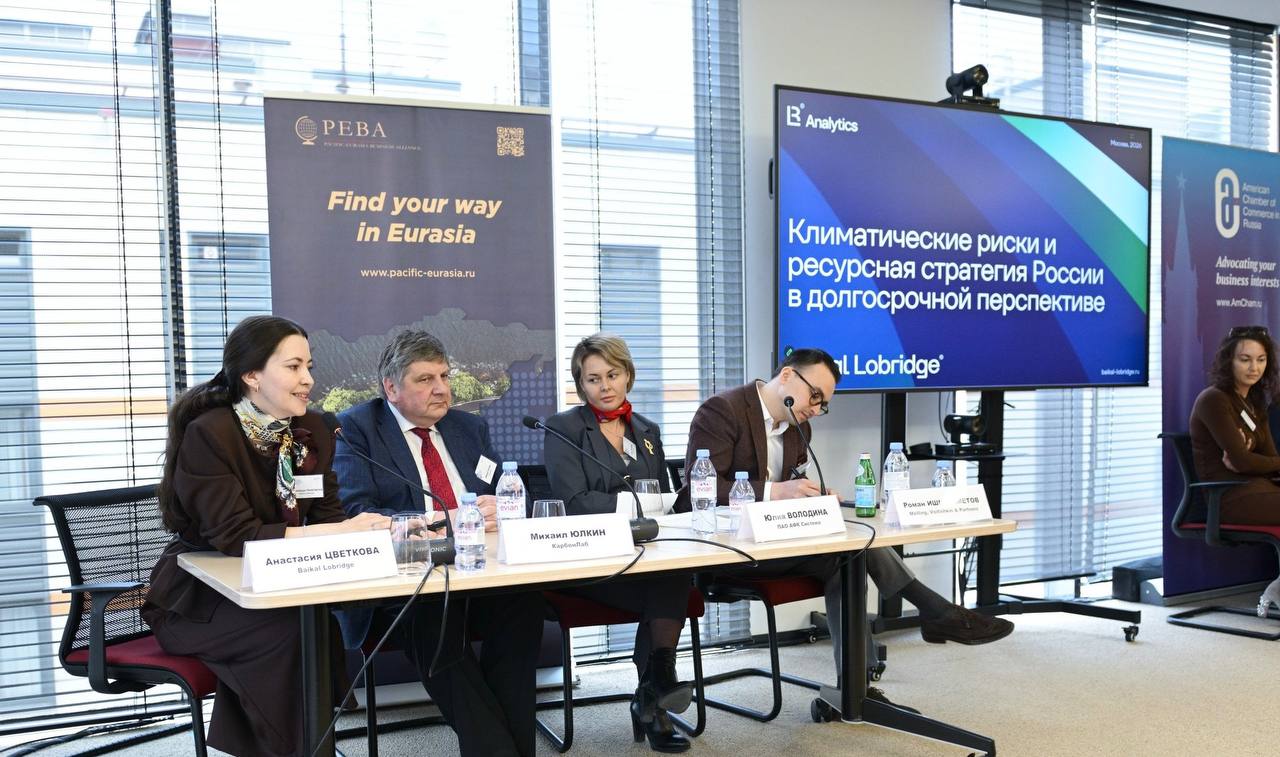
The analytical center of Baikal Lobridge has prepared a report examining how climate risks are evolving and what they may mean for Russia’s sustainable development through 2030. The study was presented by Senior Partner for Climate and Sustainability Anastasia Tsvetkova at the ESG conference of the American Chamber of Commerce in Russia on April 21, 2026.
The report explores how changing climate conditions, growing geo-economic fragmentation, and institutional factors are shaping a new model of sustainable development and climate risk management. In this model, the key issue is no longer simply the availability of resources, but the ability to manage them effectively.
The full report in English is available here.
The report explores how changing climate conditions, growing geo-economic fragmentation, and institutional factors are shaping a new model of sustainable development and climate risk management. In this model, the key issue is no longer simply the availability of resources, but the ability to manage them effectively.
The full report in English is available here.
Increasing climate volatility and regional divergence
Although overall warming is expanding areas with potentially more favorable conditions, climate dynamics in Russia are becoming increasingly unstable. By 2030, the frequency of extreme weather events is expected to rise, permafrost thaw will accelerate, and regional disparities in climate risks will become more pronounced.
Southern regions, where much of the country’s population and agricultural production are concentrated, are already experiencing growing water stress. At the same time, northern and eastern territories face mounting infrastructure risks due to permafrost degradation. Together, these trends create a structural imbalance between the country’s economic core and areas that may benefit from shifting climate conditions.
Southern regions, where much of the country’s population and agricultural production are concentrated, are already experiencing growing water stress. At the same time, northern and eastern territories face mounting infrastructure risks due to permafrost degradation. Together, these trends create a structural imbalance between the country’s economic core and areas that may benefit from shifting climate conditions.
Resource abundance as a development tool
The report emphasizes that large reserves of water, land, and energy are no longer sufficient on their own to ensure sustainable development. What matters increasingly is the ability to convert these resources into higher value-added products and integrate into global supply chains.
Special attention is given to the concept of “virtual water” — the export of water-intensive goods such as food, energy, and industrial products. In a world facing growing water scarcity, this could become an important channel for strengthening Russia’s position in international markets.
Special attention is given to the concept of “virtual water” — the export of water-intensive goods such as food, energy, and industrial products. In a world facing growing water scarcity, this could become an important channel for strengthening Russia’s position in international markets.
“To fully leverage Russia’s water advantages, it is essential to improve water-use efficiency, expand production of water-intensive goods, and secure stable access to international trade channels. More broadly, climate risks should be treated as a core factor in strategic planning, alongside geopolitical uncertainty. Over time, the focus should shift from raw-material exports toward products with higher added value,” noted Anastasia Tsvetkova during her presentation.
Geo-economic constraints on resource potential
According to the authors, markets for food and water-intensive products are likely to become increasingly politicized by 2030. Sanctions regimes, trade restrictions, and the emergence of regional economic blocs are making global resource flows less predictable and less economically rational.
In this environment, Russia’s ability to realize its potential in the “virtual water” trade will depend not only on domestic efficiency, but also on access to reliable international trade channels and the quality of its economic partnerships.
In this environment, Russia’s ability to realize its potential in the “virtual water” trade will depend not only on domestic efficiency, but also on access to reliable international trade channels and the quality of its economic partnerships.
Infrastructure management as a policy priority
A significant share of climate risks is linked to infrastructure conditions. Permafrost thaw, rising pressure on water resources, and the growing frequency of extreme weather events will require large-scale modernization of transport, energy, and municipal infrastructure.
Russia’s ability to mobilize resources centrally and implement major infrastructure projects could become a competitive advantage. However, the effectiveness of such an approach will depend heavily on coordination between federal and regional authorities.
Russia’s ability to mobilize resources centrally and implement major infrastructure projects could become a competitive advantage. However, the effectiveness of such an approach will depend heavily on coordination between federal and regional authorities.
Toward a proactive risk management model
The report highlights a shift from reactive responses to climate events toward a more systematic approach to risk management. In a climate system characterized by nonlinear dynamics, extreme events — such as wildfires, droughts, and floods — are increasingly the main drivers of economic losses and strategic reassessments.
Developing digital monitoring, forecasting, and early-warning systems therefore becomes a key priority for improving the resilience of both the economy and infrastructure.
Developing digital monitoring, forecasting, and early-warning systems therefore becomes a key priority for improving the resilience of both the economy and infrastructure.
Conclusions
By 2030, climate transformation is likely to create both new opportunities and new constraints for Russia. The country’s future potential will depend less on the sheer scale of its natural resources and more on how efficiently those resources are used, how well infrastructure adapts to changing conditions, and how effectively the country integrates into a shifting geo-economic landscape.
In this context, sustainable development will increasingly depend on balancing domestic adaptation with external economic strategy — with climate risks becoming one of the key factors shaping long-term decisions rather than a distant background concern.
In this context, sustainable development will increasingly depend on balancing domestic adaptation with external economic strategy — with climate risks becoming one of the key factors shaping long-term decisions rather than a distant background concern.